

Katie kept a diary during her 3-week stay at Skriðuklaustur artist’s residency in East Iceland this September.
Sunday, Aug. 30, 2026
Joe and I explored the herb garden this afternoon, our first full afternoon here. It’s out behind the house, very likely where it would have been hundreds of years before that, when the grounds belonged to a medieval monastery. The excavated ruins sit just a few yards away. Looking at the bushy plants I could identify the yarrow, but I didn’t know the others and had to look them up. That tall hearty looking one is angelica, which grows in cold and subarctic climates, and apparently you can eat every piece of it.
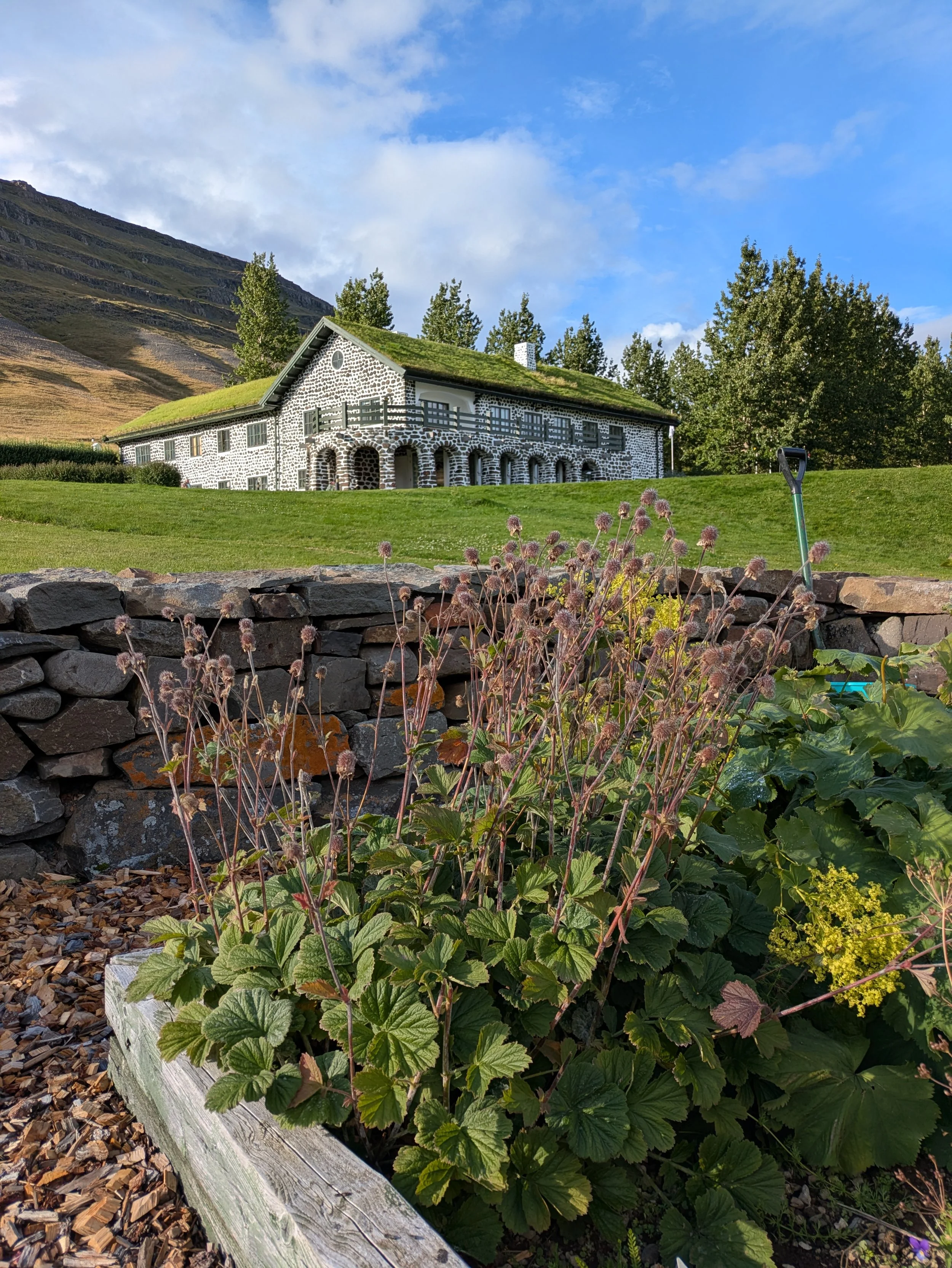
We are staying for the next few weeks in remote east Iceland, doing an artist’s residency at the former home of writer Gunnar Gunnarsson. Before that it was the monastery, Skriðuklaustur, which was abandoned in the first years of the 16th century, then forgotten and buried until 2000, when an archaeologist named Steinunn Kristjánsdóttir suspected there may have been one here and dug it up. Her excavation took around 10 years and uncovered a lot of important information about Iceland’s history.
The researchers found medical tools and medicine vials, and a pollen analysis showed that non-native healing plants were cultivated at Skriðuklaustur during the monastic period. To everyone’s surprise, 300 bodies were also found buried here, a decent number for a place with such a small population. The skeletal remains show that the people suffered from illnesses, traumatic injuries, and disabilities. They had venereal disease, dental disease, arthritis, Down Syndrome, tuberculosis, sinusitis, gingivitis, paralysis, Paget’s disease. They can tell all of this from the bones, and this plus the information they got from the soil that healing plants were cultivated there means that the monastery served as a hospital. People went there for treatment and care when they were sick and in pain. It had been assumed that in such an out-of-the-way place, the monks who lived here would have lived a cloistered life of prayer and solitary work, when in fact they served the community and travelers in need.
As a witchy sort, learning about the healing garden gave me a thrill. I’ve been interested in herbalism for a long time—even dabble in it a bit by making tinctures and salves and using them around the house and on my skin. Everywhere I’ve lived, I’ve cultivated a little herb patch; it’s the only sort of garden I’ve been able to grow with any prolonged feeling of dedication. I love the way my favorite ones look, smell, and taste—lavender, rosemary, sage, basil, thyme—and there’s just something so cool about the idea of a “useful plant,” about having that kind of knowledge of and intimacy with them.
The first time I studied herbs was when I belonged to a garden club outside Philadelphia, which had established and kept up the care of a “kitchen garden” attached to a local house museum. The house was built by a Quaker family from England in the 1680s, who walked to the site in the wilderness on an old Leni Lenape trail. Our club created the garden in 1994 and maintained its upkeep. They planted herbs that were used for food and medicine by the European settlers in the US at that time: lavender, chamomile, sage, lemon, mint, lungwort, celeriac, lemon balm, sweet woodruff, and others.
When I took over tending the garden I knew a little about medicinal herbs and was keen to learn more. One of the more surprising things I learned was that colonial American herbalism had its own identity distinct from the English and European approaches, due to how isolated the country was from the rest of the world. The settlers brought their knowledge with them, including their books (“herballs”), which were medieval. Medical understanding changed and advanced in Europe during those early decades of the American colonies, but it didn’t reach the isolated people who had started their lives over in this new place, so they continued working with a medieval understanding of the plants. It’s strange for Americans to think of their young country as having brushed up against the Middle Ages, but in this sense at least, it did.
Tuesday, Sept. 1
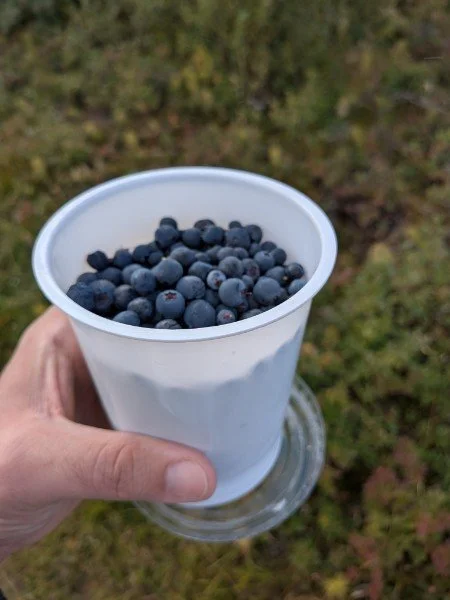
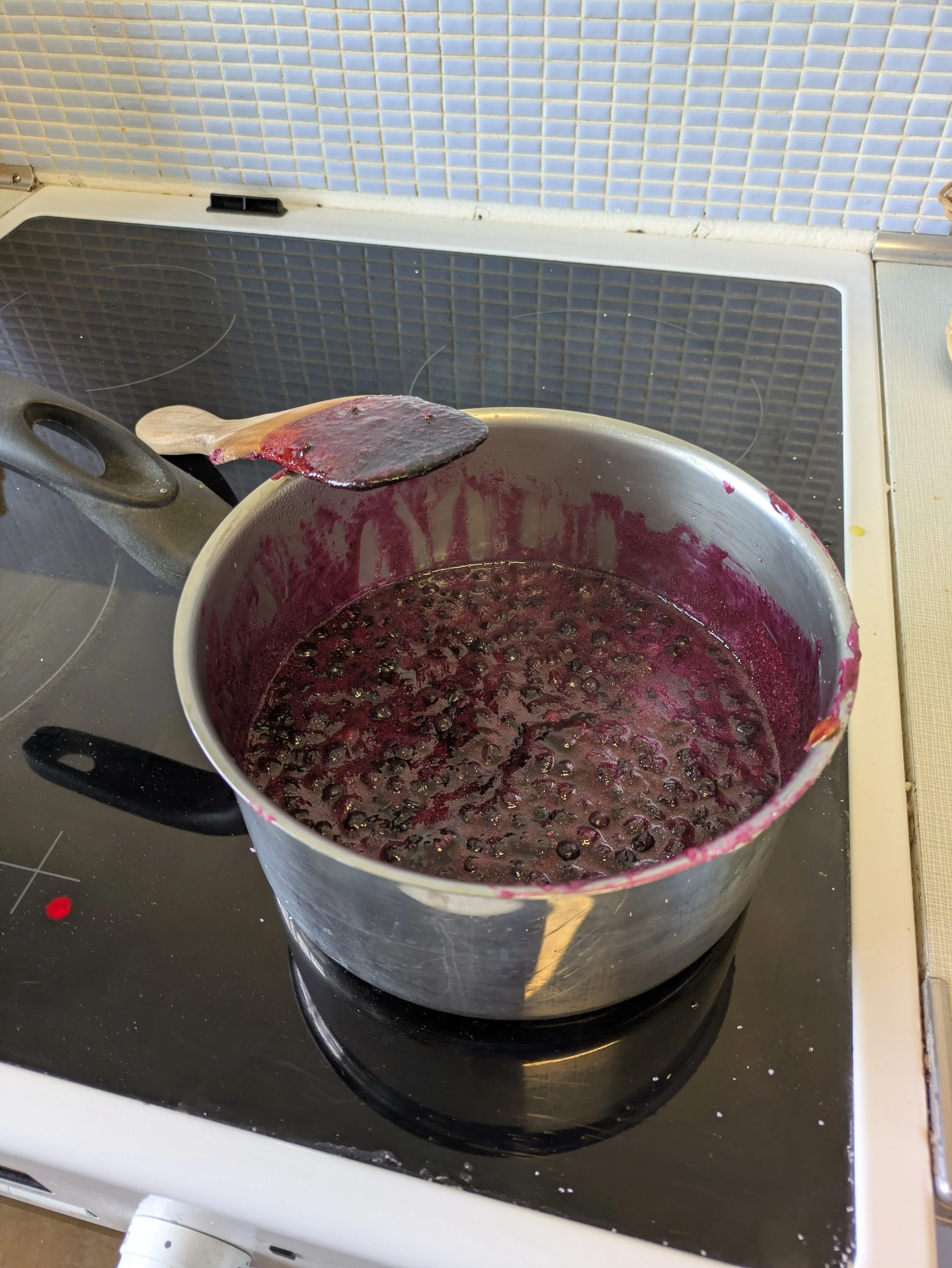
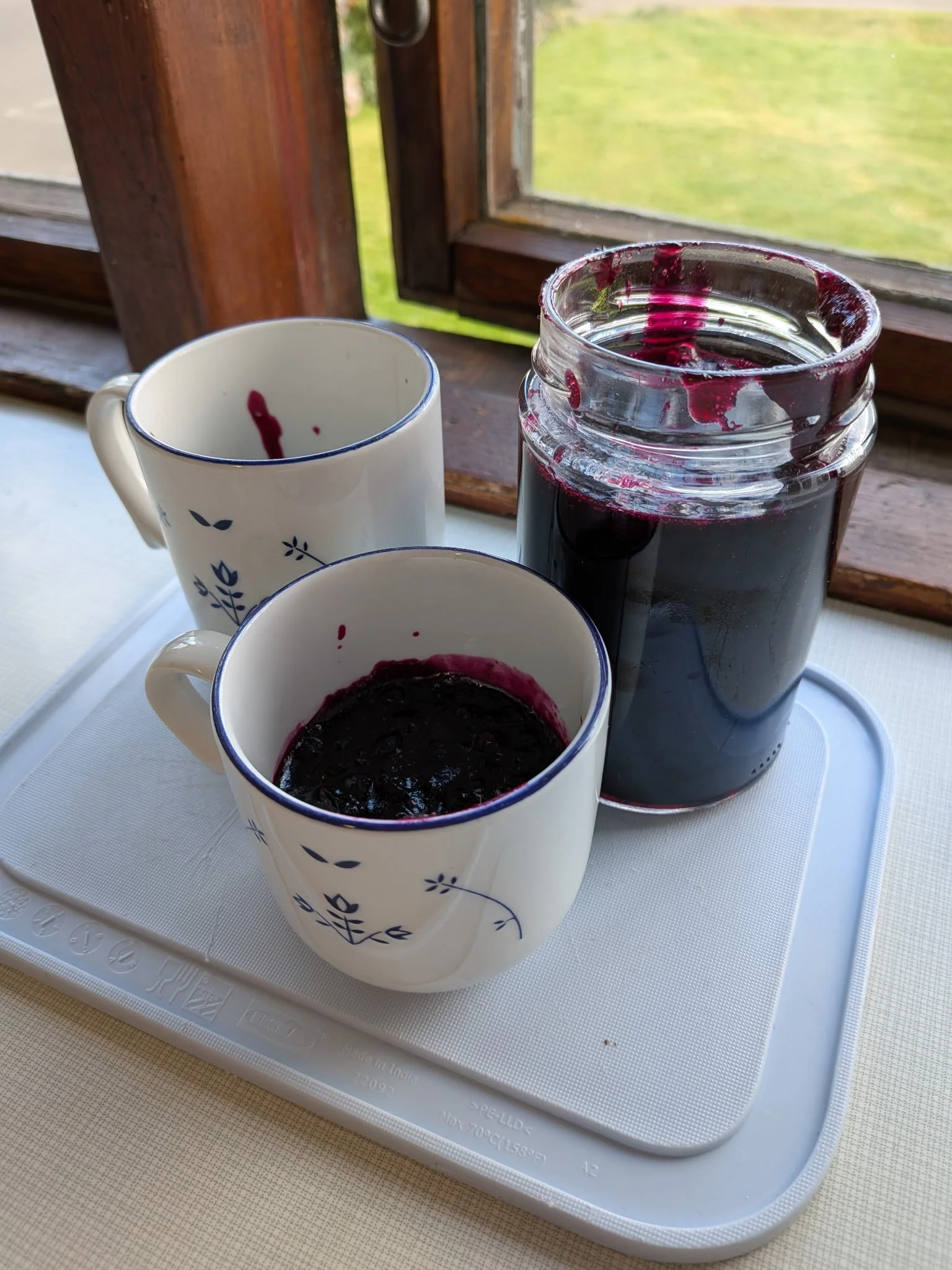
Joe and I are here to work on poetry and music stuff, and for the last few days we’ve been going out to the woods to walk and collect sounds that we might turn into some kind of sound collage. Joe also took photos of all the flowers he saw, and while doing this he noticed a number of berries growing in the low shrubs. Back at the apartment he looked them up and found out that the ones we thought were blueberries are called bilberries—similar, more common throughout Europe than at home, and apparently, even sweeter. He had the idea to come back on Tuesday, before the freezing temperatures that were forecast for that night, and collect enough bilberries to make jam. It was easy to find enough berries to fill a yogurt cup, and easy to make the jam. (Especially easy for me because I sat at the kitchen table listening to music and watching Joe do all the work.) The blueberries have enough pectin in them that all you have to add is sugar, then cook them on the stovetop.
Wednesday, Sept. 2
It was sunny today, so after Joe and I hung my art show in the small gallery room we sat on the patio of the restaurant, which we had to ourselves, and drank beers. After a while we wandered back into the building and upstairs to our apartment. Finally my nerves were gone; the show had been hung and I didn’t have to prepare for or anticipate this particular scary event ever again. We settled down for a quiet late afternoon.
There is something incredibly delicious about “living” in a museum. It’s a sort of fulfillment of that fantasy of getting locked in one overnight and seeing if the exhibits, in their empty rooms, take on a different kind of life. Turns out they do, at least energetically, and we’ve kind of spooked ourselves creeping around down there after hours, in part because we feel like we’re actually not supposed to be doing that. But we do have to walk through the halls and past the restaurant and the kitchen to get to the laundry room, which we wait to do until the staff have gone home. It’s eerie and it’s cozy, both at once.
This afternoon, tucked up in the sitting room of our flat, we heard popping sounds outside that we thought were gunshots. We went to the window. From there we watched as three tiny figures, two men and a dog, folded themselves into a copse of trees at the back of a field and shot at geese flying overhead. They got at least one—we could just about make out the shapes of a man running toward something in the field, picking it up and walking back with it to his hiding spot. They seemed to stay out there for a few hours, until it seemed like it would be too dark to see any geese, and when the headlights of their truck flashed inside our window we knew they had finished and were driving away.
Friday, Sept. 4
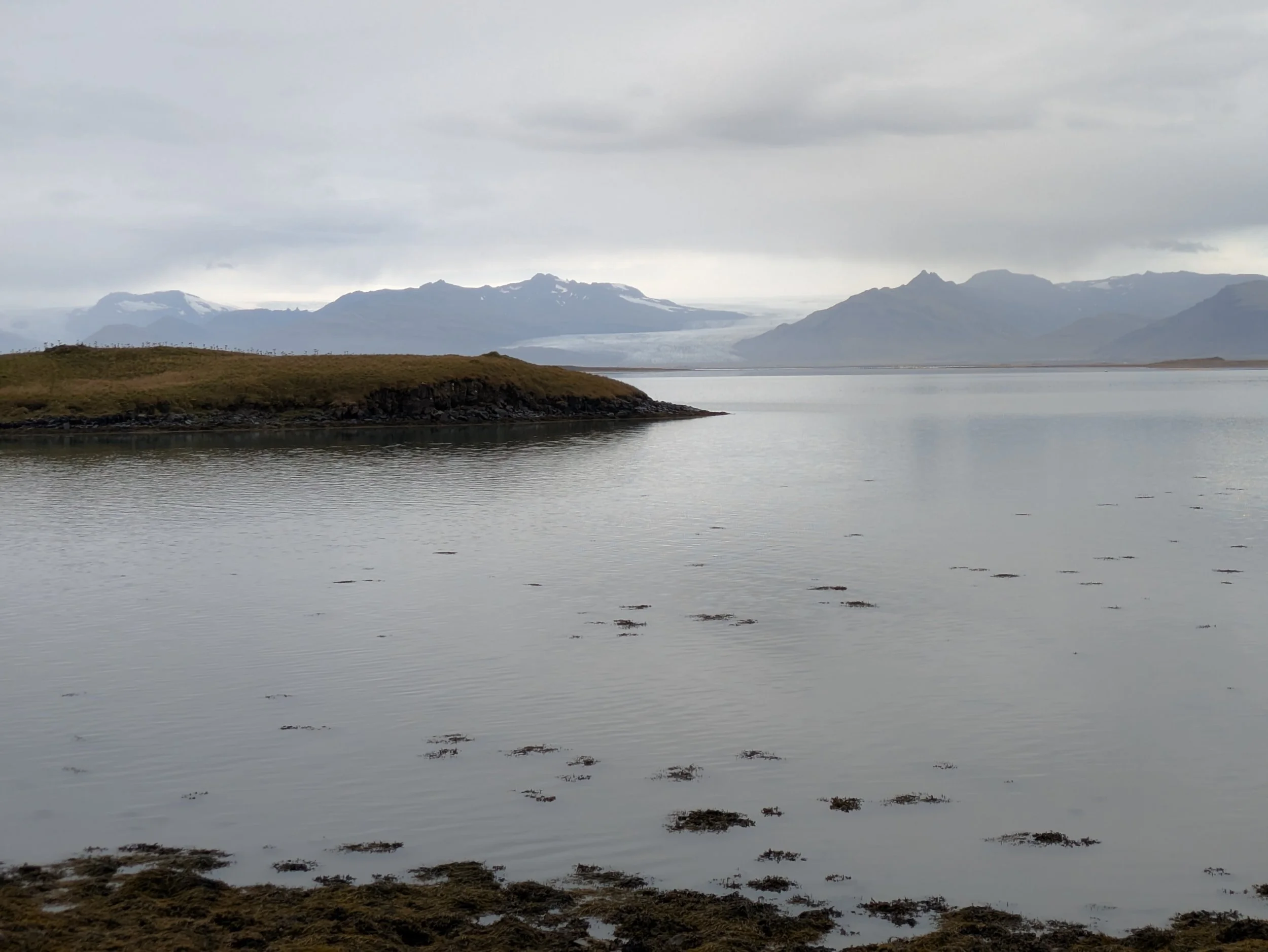
This morning we went back out into Hallormsstaðaskógur Forest to collect more sounds. This time we brought our hydrophone to the lake. Joe tossed it out into the water and I tossed big rocks and sprays of little pebbles around it to capture the sounds they made underwater. On one little beach I found such a wide variety of stones, I felt as excited as a little kid. I even tried to convince myself that one clear hunk was Iceland spar, but I think it’s just a piece of glass.
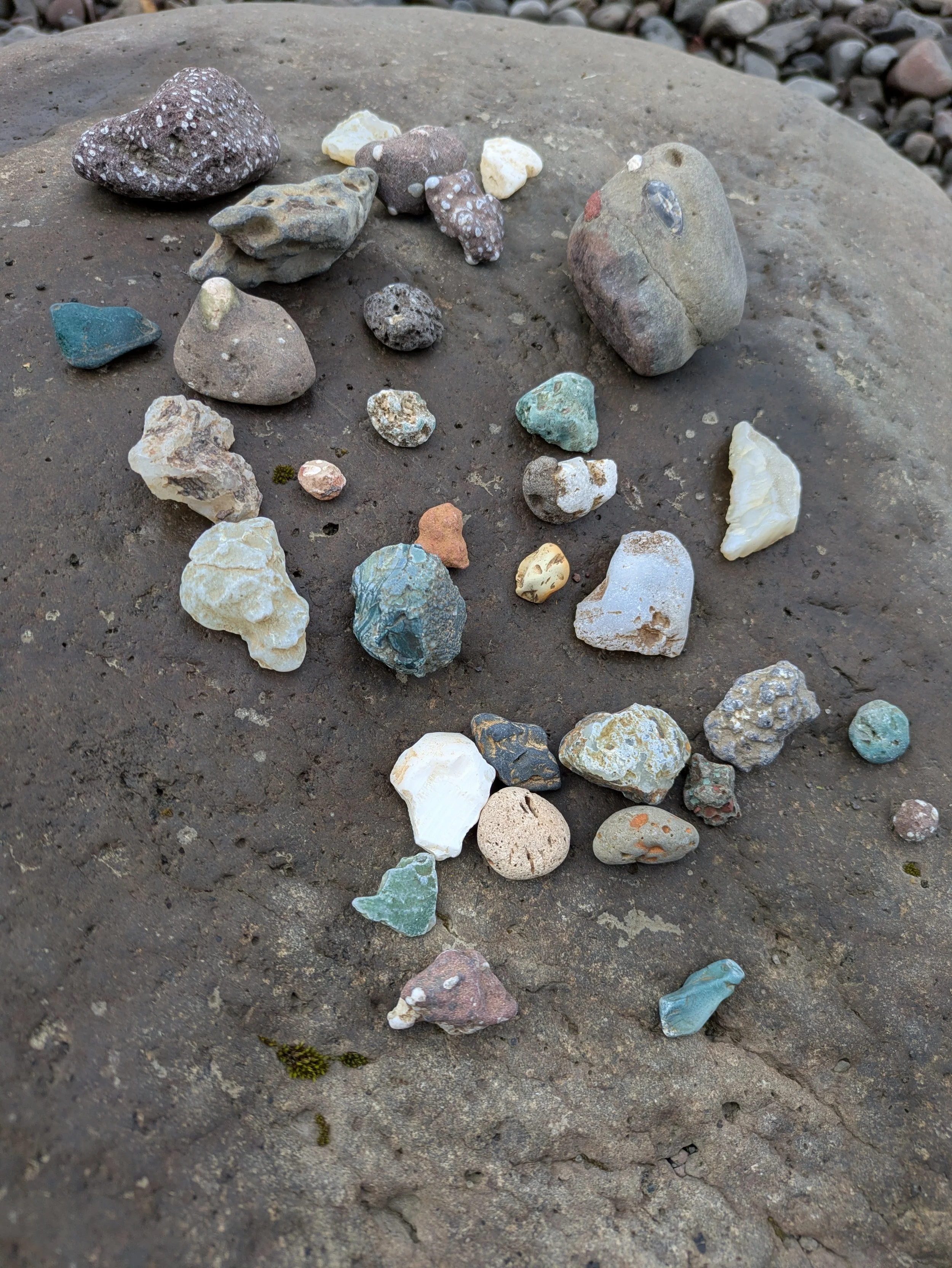
Joe and I have gotten into “rockhounding” over the last couple of years, but so far we haven’t gone looking for rocks very far from home. We live near the Wissahickon in Philadelphia and are able to find garnets, schist, jasper, and quartz. We even joined the Philadelphia Mineralogical Society to try to get better at identifying them, which is harder to do based only on what they look like than we initially thought.
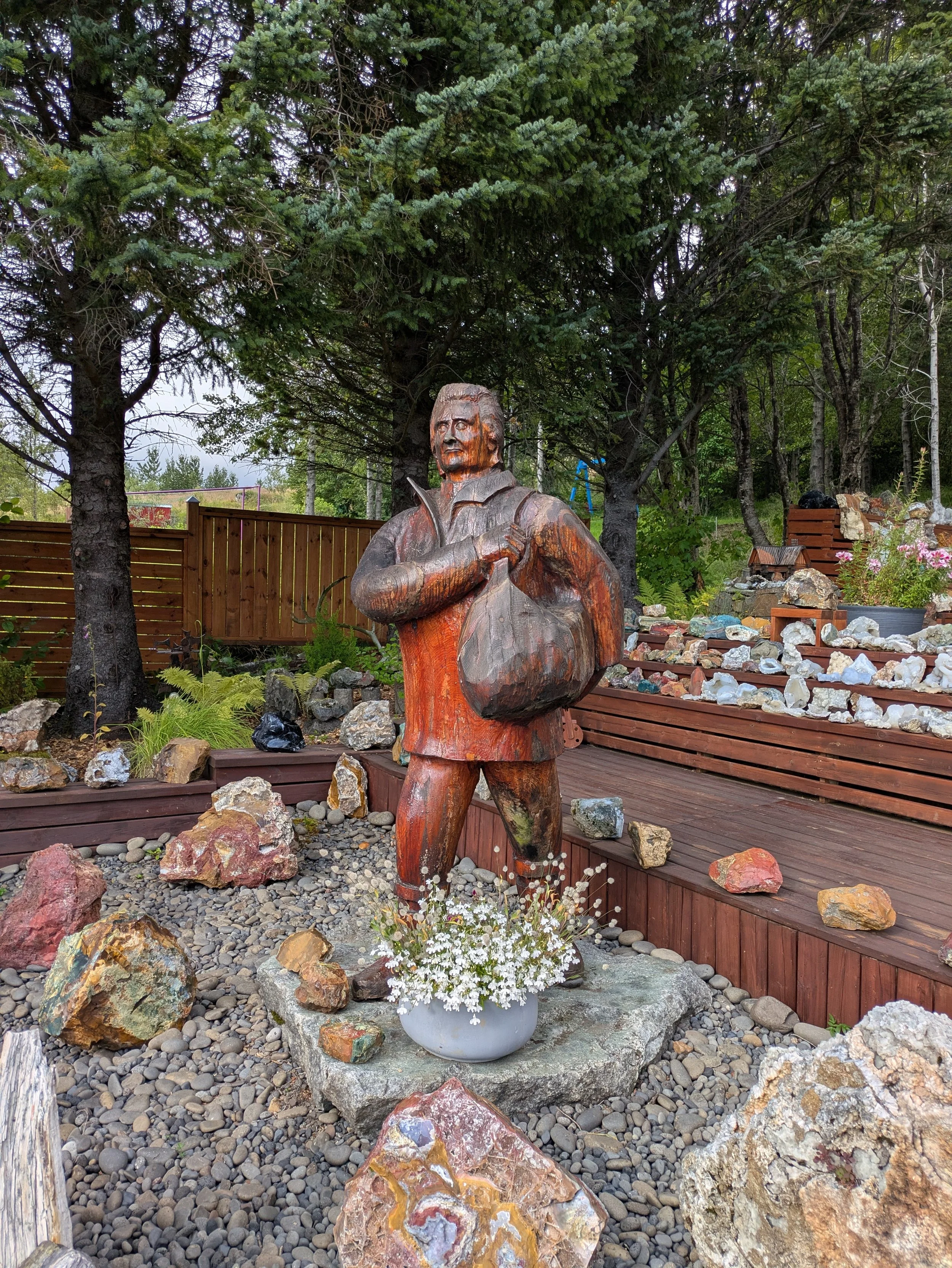
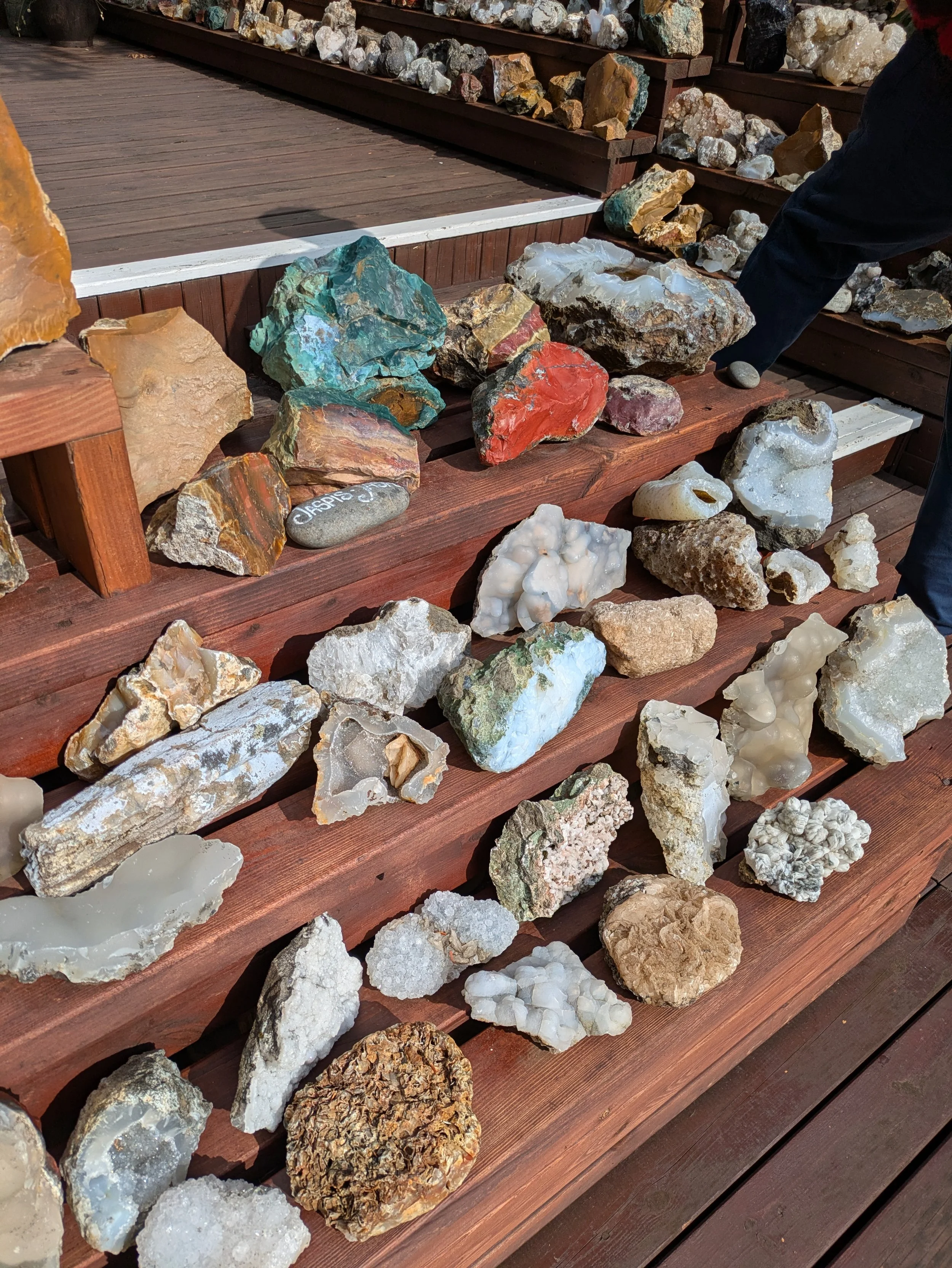
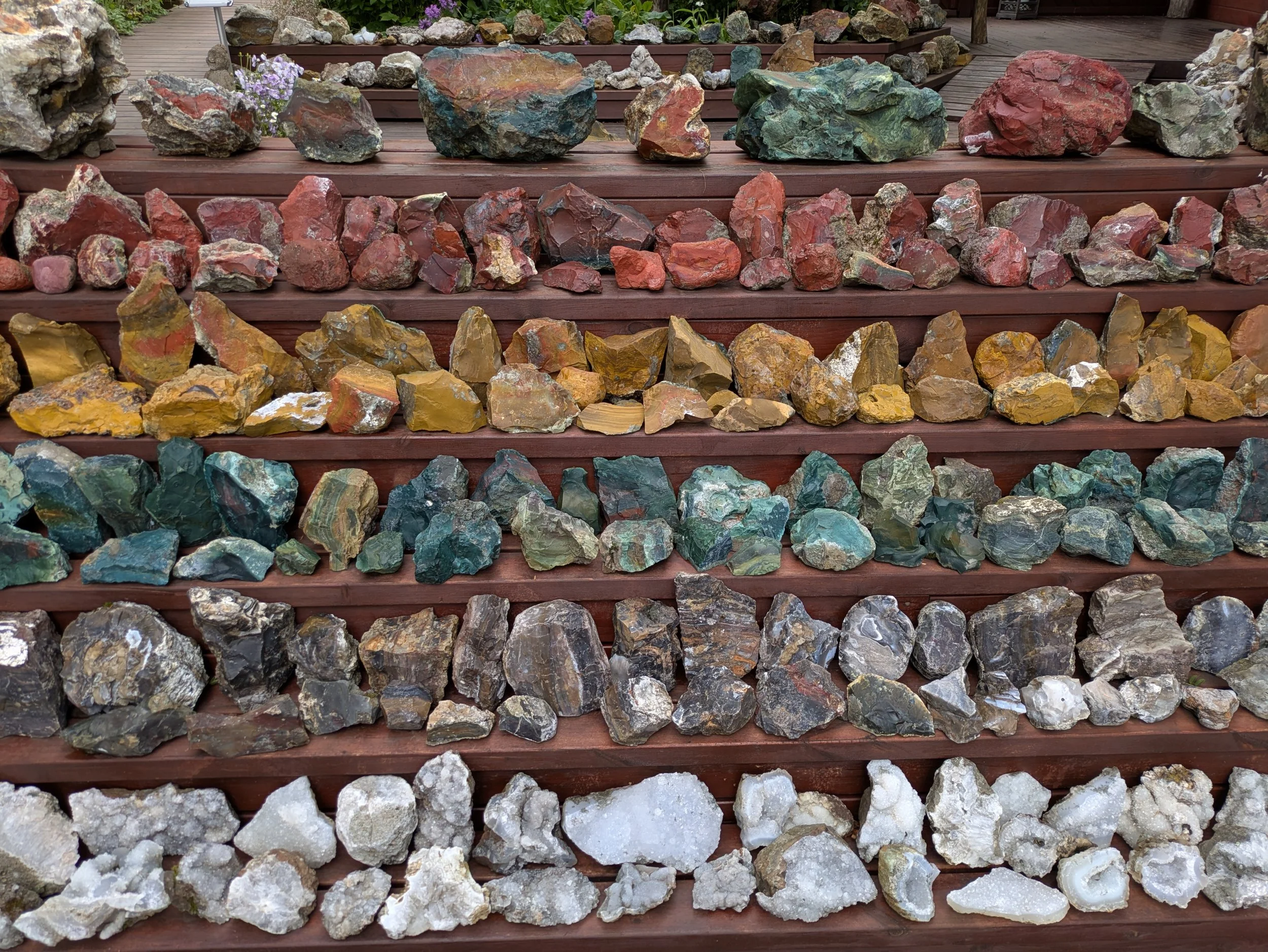
On our drive to east Iceland from the airport we passed through a small town called Stöðvarfjordur, which happens to be home to Steinasafn Petru—Petra’s Stone Collection. Petra Sveinsdóttir was an amazing woman who born in the 1920s and had an intense interest in rocks and minerals. She took frequent treks into the mountains, sometimes with her little kids in tow, to search for them. Over 60 years she brought home thousands of them, even adding to the scientific understanding of the country by donating some of her specimens for research. Awesome person. And her collection, which is run by her family in her former home, is like a rainbow of colors. I never would have guessed such a huge variety of rocks existed in this one place.
Saturday, Sept. 5
I’d feel guilty if I kept this diary about my time at Skriðuklaustur and never talked about Gunnar Gunnarsson, the famous writer who built and lived in this sod-roof house with his family in 1939. He wrote a lot of books, but sitting in the living room of the apartment and looking at the large bookcase there, my eyes were drawn to Advent, a beautiful novella that is apparently one of his best loved ones. I love a pink Christmas motif. It seemed like the one to choose.
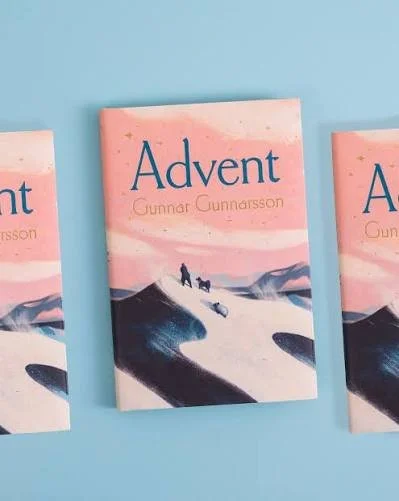
Photo credit: Vintage Books
I finished reading it tonight. What a stunner. It was originally published in Danish in 1936 and first translated into English in 1939, and was pretty popular in the U.S. the next year, when it was a Book of the Month Club book. It’s thought to have inspired Hemingway to write The Old Man and the Sea. This edition, with a new translation by Philip Roughton, came out in 2025.
The novella is the story of a farmhand in his 50s named Benedikt who’s making his 27th December expedition into the mountains to bring home any sheep that the local farmers may have missed during earlier herding trips. It’s a daredevil adventure story, worrisome as you come to care deeply for this man and his beloved companions, the sheep Eitill and the dog Leó—it’s also slyly funny, and so sweet. I deeply loved reading this book. I can imagine someone, maybe me, reading it every year in December, as the writer Jón Kalman Stefánsson wrote that he does in a beautiful afterword.
Bense starts out with the company of a few other men, but he’s glad when they collect their sheep and go back home, since he prefers to spend these weeks alone in this wilderness. As you might guess, much of the story is about not just nature, but weather. Blinding blizzards, shifting snowdrifts, wind that rips the words from your mouth. During the most treacherous parts of the trip, Benedikt is pushing alone through a storm in -30 degrees, and when his beard becomes so frozen over with ice that it becomes hard for him to breathe he hacks it off with a knife. He’s made of tough stuff. But what remains with you after reading the book is its philosophical tenderness, and the sweetness and depth of Bense’s relationship with his animals. His intimate connection to the place he is of, and is of him.
“He walked so well here. The snow-covered mountains seemed so low and distant in the moonlight, and here and there touches of starlight glittered against the glossy-black nighttime ice. Such a walk was like a poem with rhymes and wonderful words; it remained in the blood like a poem. And just as with a poem you might learn it by heart, so to speak – and then feel compelled to come and look here again, to make sure that all was unchanged. And so it was alien and unattainable – yet homely and indispensable. And, finally, complete calm fell over Benedikt. A sense of security deep in his heart expanded and became all-encompassing, infallible: here he walked. He walked here.”
Sunday, Sept. 6
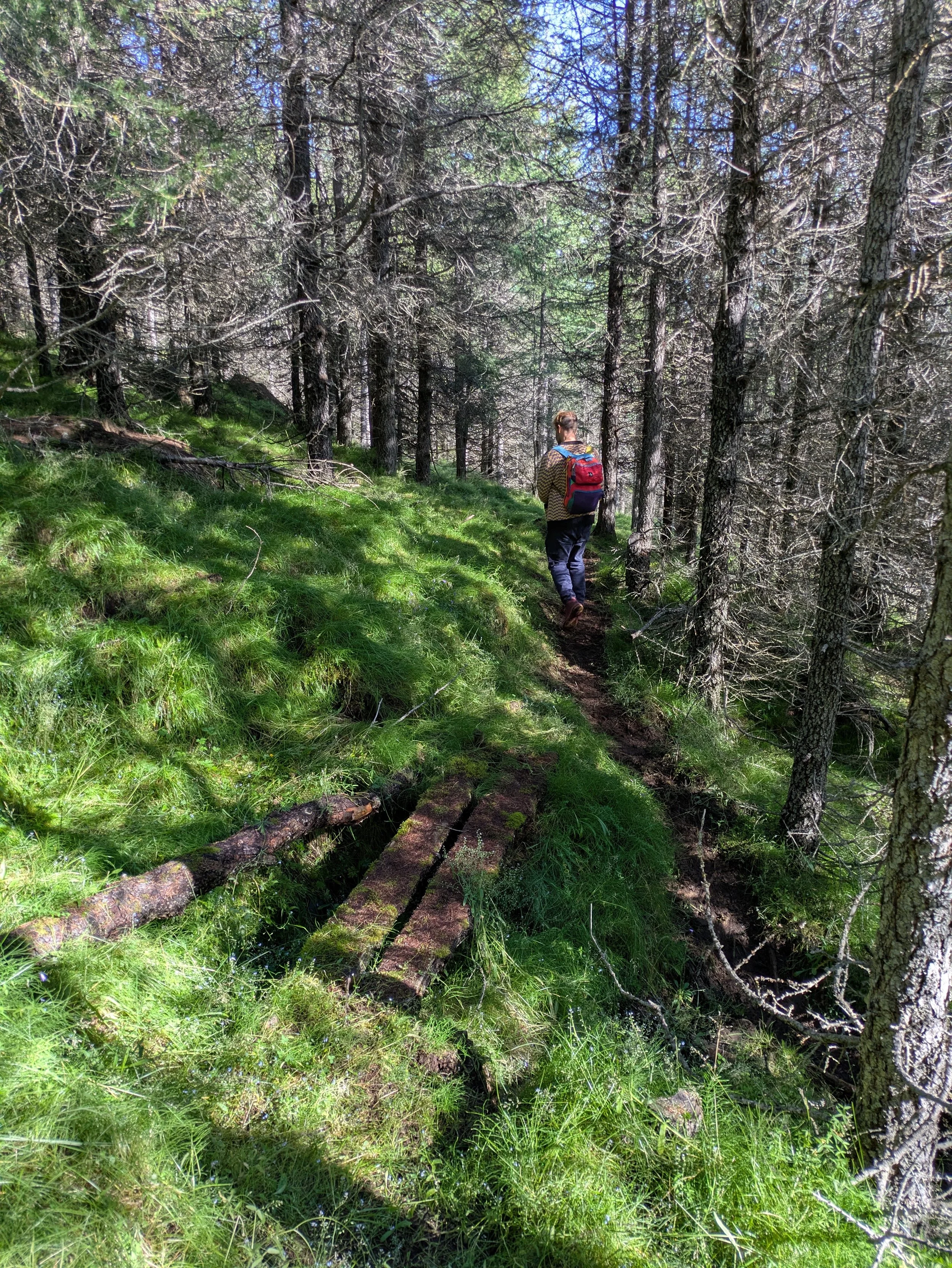
Yesterday, around twilight, Joe and I were taking a short walk on the Skriðuklaustur property when we noticed a person across the street. She was standing at the wooden gate that leads into a small woods that goes straight up the side of the mountain. It was the same spot where we’d seen a magical white horse on a different evening walk. If she was allowed to go walking back in those woods, were we? This morning Joe went downstairs to find Skotta to ask. She said absolutely, there’s a marked trail up to the ridge, where you’ll get a good view of the valley. She also described the slippery jack mushrooms we were sure to find there and encouraged us to pick them if the undersides looked “appetizing.” Sure enough we found a whole bunch that looked fresh and nice and cooked them for dinner.
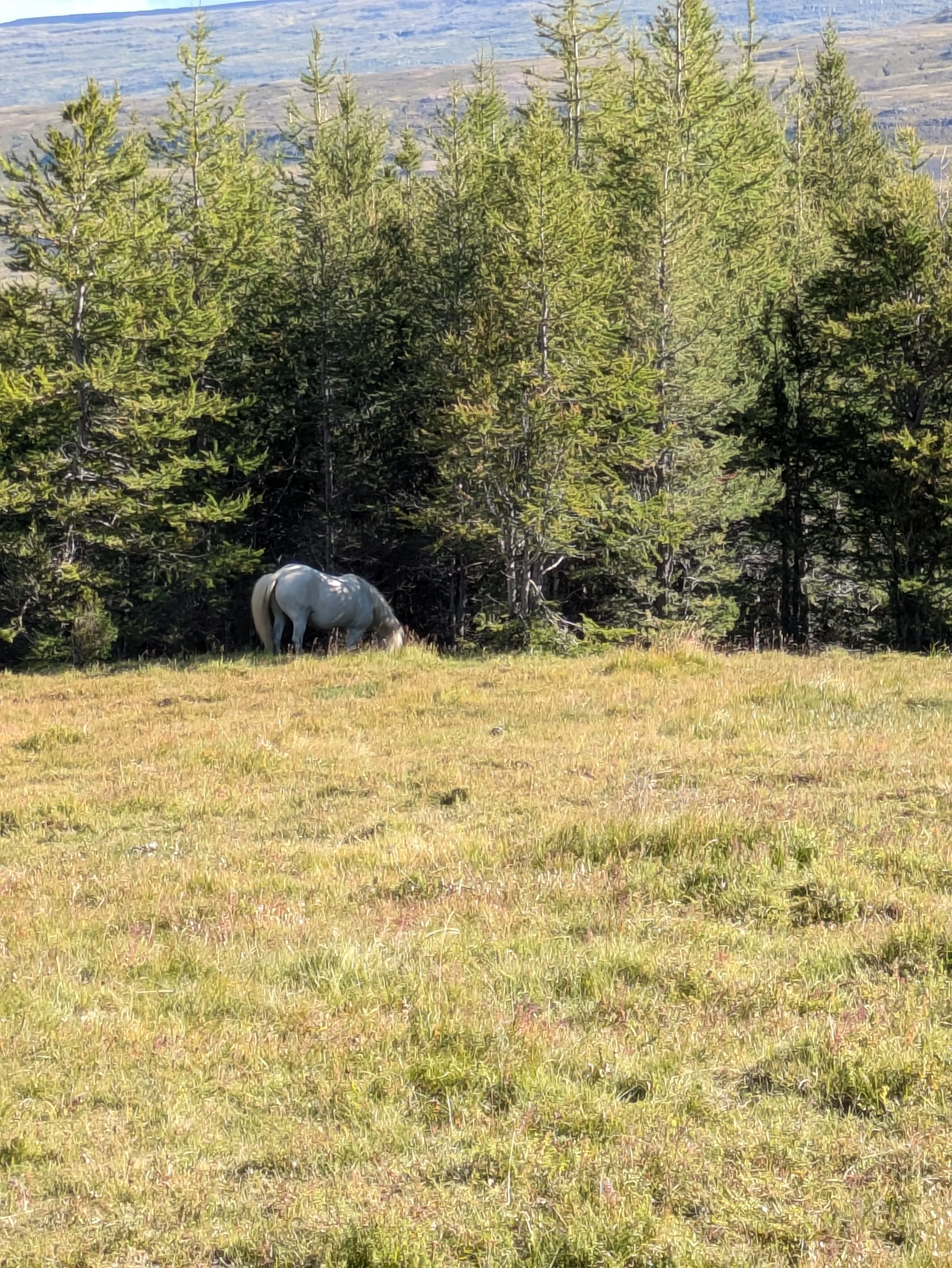
The walk through the woods was gorgeous. At midday it was sunny and bright but the breeze was cool and damp, and the grass underfoot was plush and deep. Once we reached the clearing near the ridge we came upon a small group of sheep and, near them, about 5 horses. I love to see the horses, with their long manes and bushy bangs. They aren’t afraid of people, really, so if you don’t try to approach them they’ll stay nearby. Four of the horses were different shades of chocolatey brown and the other was white, and that one somehow seemed just a little more queenly than the others. We decided it was the same one that appeared to us the other night.
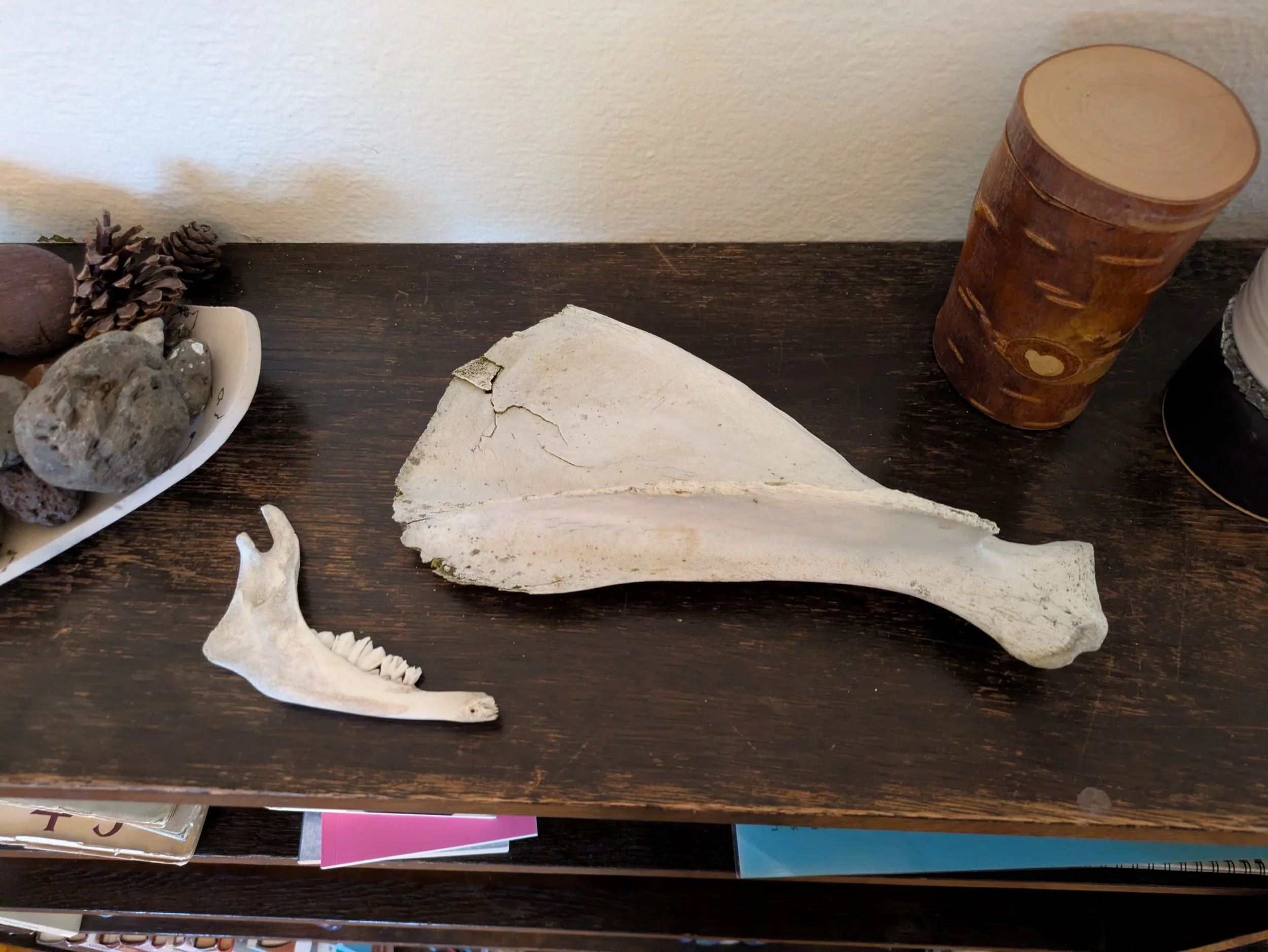
On our way back down I spotted something flat and white in the grass. I was attracted to it because it looked like a piece of paper, and I briefly imagined what a found paper on a mountain in East Iceland might say—a message from the elves, no doubt—but when I reached it I saw it was a large bone. It looks like a shoulder blade to me and it probably belongs to a horse—but what if it was a reindeer’s? I’ve been dreaming of seeing a reindeer. Apparently they won’t usually come down from the highlands until later in winter, and someone warned us that they’re very well camouflaged anyway, so we’re aware we aren’t very likely to see one this month.
In any case, the bone was a nice find. I brought it back down the mountain and added it to the collection of rocks and other natural things people have left in the apartment (including this small jaw bone. Must be a sheep’s).
Monday, Sept. 7
Today some new friends came to visit us. Katrin and Salomé are two musicians from Reykjavik whose work we really admire, and Joe invited them before our trip here to come over and make records with the travel lathe Joe built.
“Coming over” from Reykjavik actually requires 9 hours of driving. It’s a gorgeous drive but tiring. We know because we tried doing it in one day since the B&Bs we researched online were so expensive, but we gave in and stayed halfway through in a lovely comfortable hotel in a south-eastern fishing town called Höfn. Katrin has family in this part of the country so they made a trip of it, and as part of their visit the four of us spent a gorgeous afternoon together. We ate lunch in the apartment, walked around the monastery ruins while the wind tossed everybody’s hair around, and then cut a few records of a song the two musicians did together during the pandemic as part of a Radio 1.
We’d invited the girls to join us for lunch in the cafe downstairs, not realizing it was closed on Mondays and Tuesdays. Too bad, because they do a tea and cake service in the afternoon that I’ve been looking forward to trying. They bake all these beautiful cakes every day and then set them out on the table. It’s the prettiest thing.
I love Katrin’s music. Every song has an emotional immediacy to it, and they’re musically interesting, catchy and pretty and fun. Her artist name is K.óla. She showed us four videos she had made from songs on her new album, each by a different filmmaker, which will come out in December. Joe, Salome, and I all straight-up cried at the tender song about her grandmother, who loved birds.
Incidentally, I showed Salomé the clavicle bone I found—I’ve been pestering everyone about this bone, hoping they’ll tell me it belonged to a reindeer—and she said she thought it was more likely to be a reindeer’s than a horse’s, since why would a farmer leave one of his horses or rams to die and turn to bones? So maybe I’m closer to reindeer here than I thought.
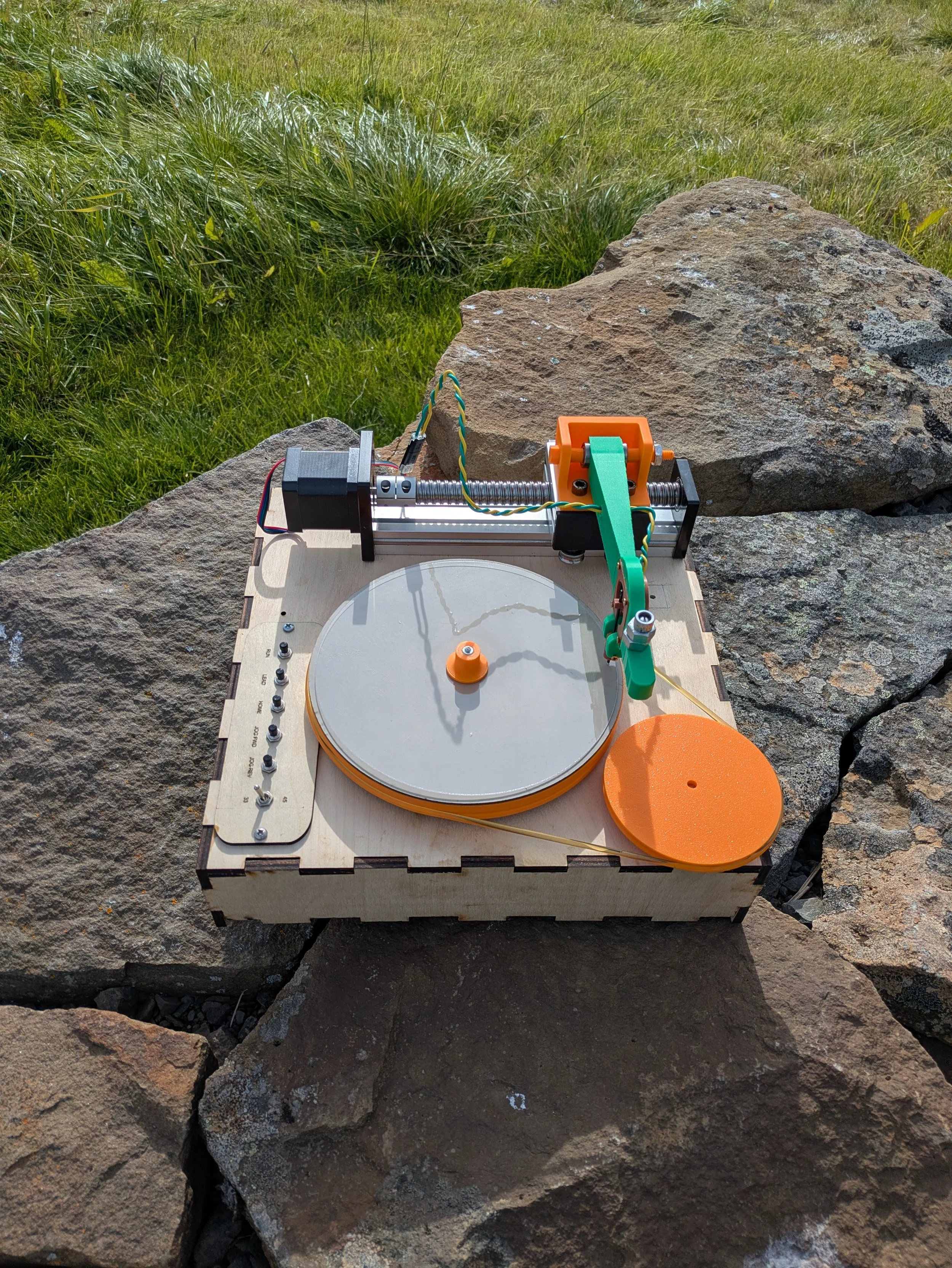
Joe’s incredible little “travel lathe,” which he and our friend Mark Robinson built together in anticipation of our trip to Iceland. We expected this to show up looking scary on the airport security CT scan, but no one was fussed.
Tuesday, Sept. 8
Every day Joe has been checking the website of the Icelandic Meteorological Office, which shows you weather conditions in Iceland by the hour, including the chance of seeing the aurora borealis and the amount of cloud cover. Last night the chances were pretty high for both northern lights and not too many clouds, which meant the potential for a good show. Around 10 p.m. I got out of my pj’s and back into my long johns and sweats and coat and hat and gloves, and we went outside.
In order to get a better look at the sky we walked to the small viewing platform that overlooks the monastery ruins. It’s darker there, away from the lights that ring the house, and from that spot you can see way down the valley on either side. There are only a few lights from houses dotting the huge valley Fljótsdalur, which reminds me of the moors sometimes, and other times makes me think of pictures and films I’ve seen of Wyoming—fields spreading out in front of you with mountains on the horizon. Only around 100 people live in the valley—“or 102 right now, since 3 weeks is a long time to stay somewhere,” as our young museum tour guide said when talking about the valley’s population, sweetly including me and Joe.
But we did, we saw it. The northern lights. It was stranger than I thought it would be, almost disorienting. I’m already not used to such a huge, dark night sky. The way it curved around us, it felt close somehow, almost overwhelming. And then overheard, for just a few minutes, was a green twisting streak of fire, with small green flames licking the sky on either side.
Wednesday, Sept. 9
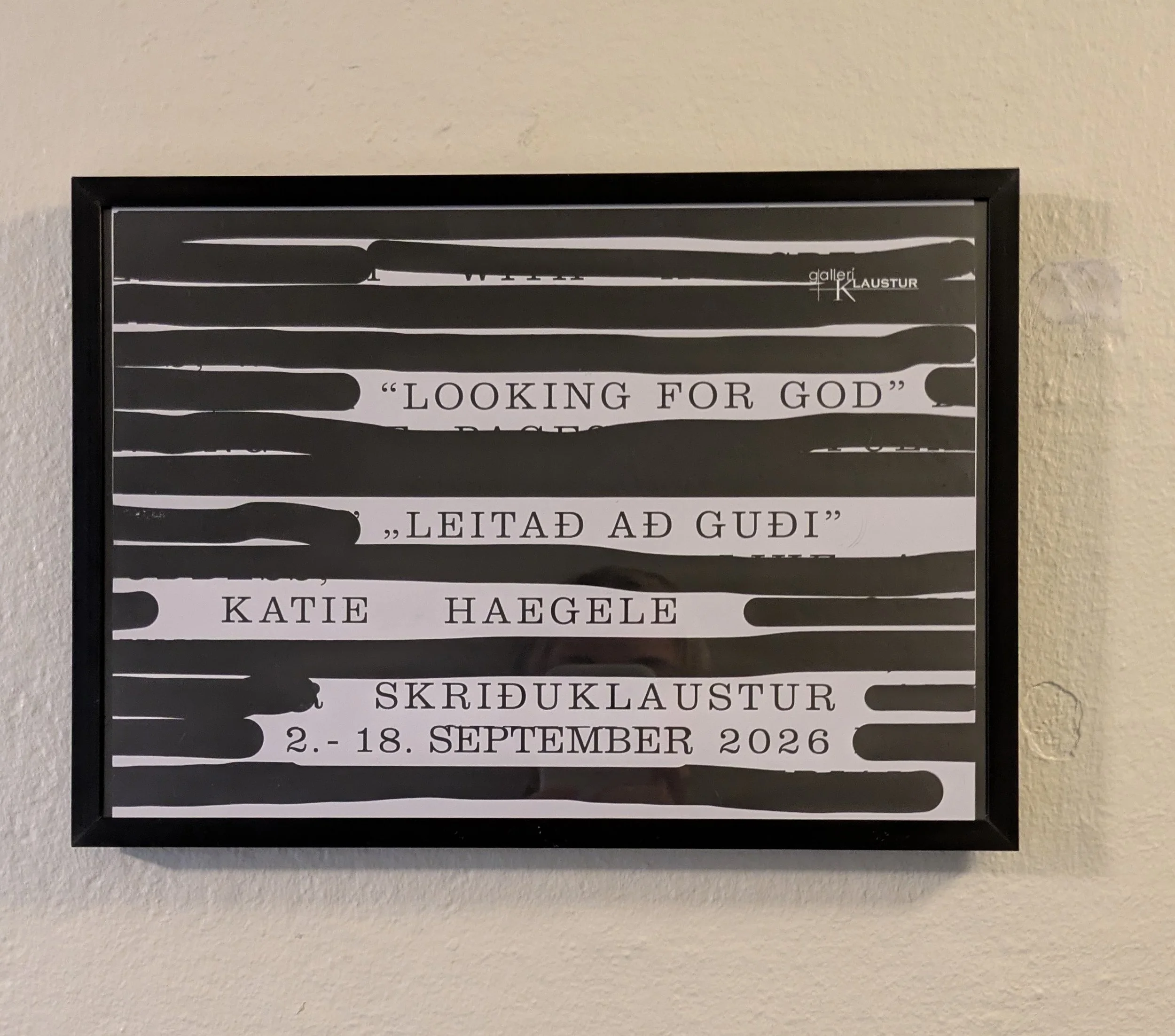
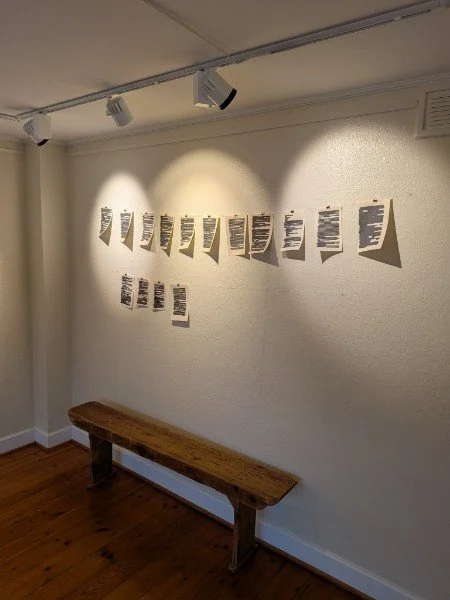
Just a week ago I hung my art show in the gallery downstairs. A couple months before we came here they offered us the opportunity to show our work in the gallery, if we wanted, though it wasn’t a requirement of the residency. It was too good an opportunity to pass up, so Joe helped me make prints of about 100 of my “looking for god” poems with the idea to hang them simply, clipped to a wire in a row like laundry on a line. These are blackout poems that I make from the pages of novels, most often juicy genre fiction like romances and thrillers. It’s the “writing” project I’ve gotten the most out of over the last 4 years, since I started making them—and I do think of it as writing, albeit a blend of some kind of traditional writing practice and a form of divination. I open a book more or less at random and let the words that are already there come together to make new meanings, just for me.
I’ve got around 130 or so of these poems made now, and the whole time I’ve worked on them I imagined showing them in an art space rather than publishing them in a book, though ultimately I’d like to do both. Something about being confronted with them in a room feels truer to the experience I want the reader to have.
I love found poetry and blackout poetry; the experience of looking differently at something that is already there is exciting and gratifying to me. Digging for a poem in a non-poetic context gives me the same pleasure that digging through old stuff at the thrift store gives me, or combing a creek for cool rocks. Looking, digging, for beauty that is already there, but you have to work for it a little. Then you get a reward. I’ve made blackout poems on all kinds of subjects, but the synchronicity of literally “looking” for god felt so right the first time I did it that I haven’t been able to stop. I brought a stack of about 75 pages with me to work on new poems while I’m here.
Typically what I have done is passed my eyes over the pages of a novel, looking for dialogue (or inner monologue) that contains the word “god.” Characters say it all the time in certain kinds of stories: “Oh my God!” or “for God’s sake” or “God knows…” Then I work to build a poem around this word—or the word “goddess” or even less frequently, “gods.” Some of the poems address god directly, some of them are about the idea of god. A lot of them come out funny, though I try not to lean too heavily on humor. But one interesting thing that has happened in the week since I hung the show is that I’m shying away from using the word god at all. It suddenly feels too limiting. The new poems I’m making are about the infinite, still, but in a slightly more roundabout way. I was proud to share the poems in this show, and now I’m surprised and pleased to see that sharing them means expanding my relationship with them.
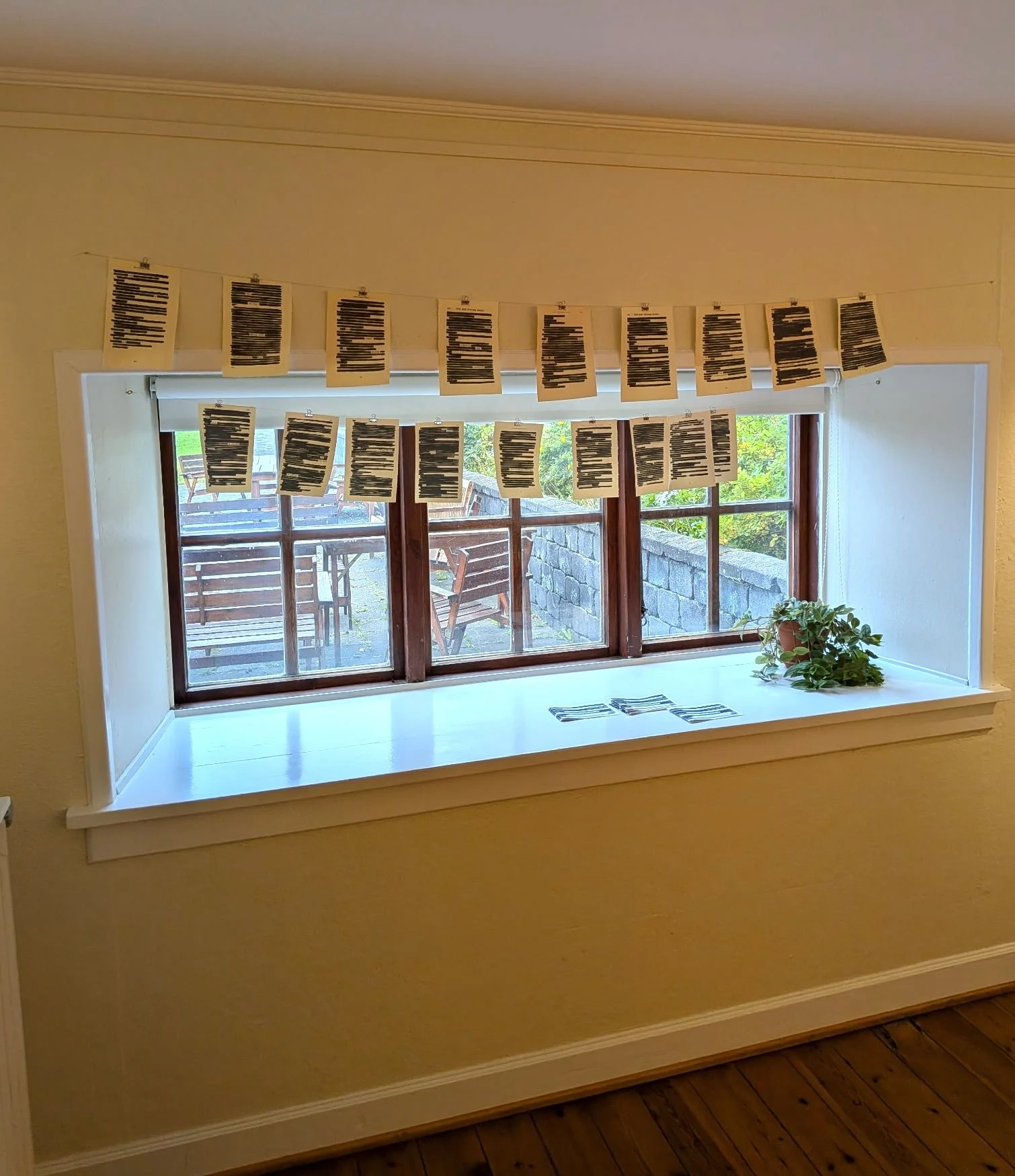
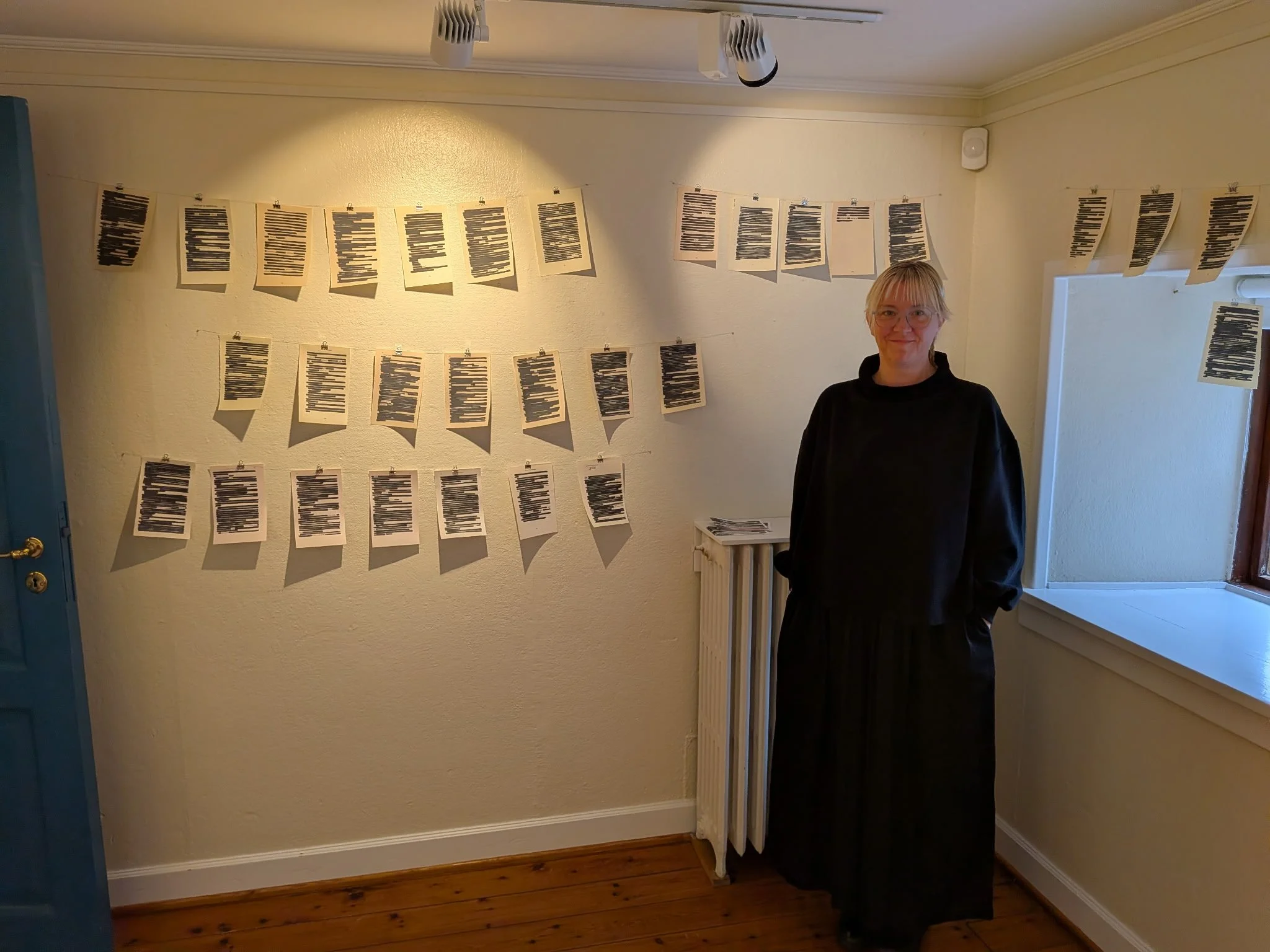
Thurs. Sept. 10
Yesterday we had the pleasure of visiting The Fish Factory, a large artist space in a converted factory thatI wrote about in detail below. We saw lots of inspiring stuff there, including an installation by Icelandic artist Saga Unn called Beðið (a flowerbed / waiting) that was being exhibited in space. Part of the artist’s “Textbook Series,” for which she transforms spaces with sculptures made from recycled textbooks and schoolbooks.
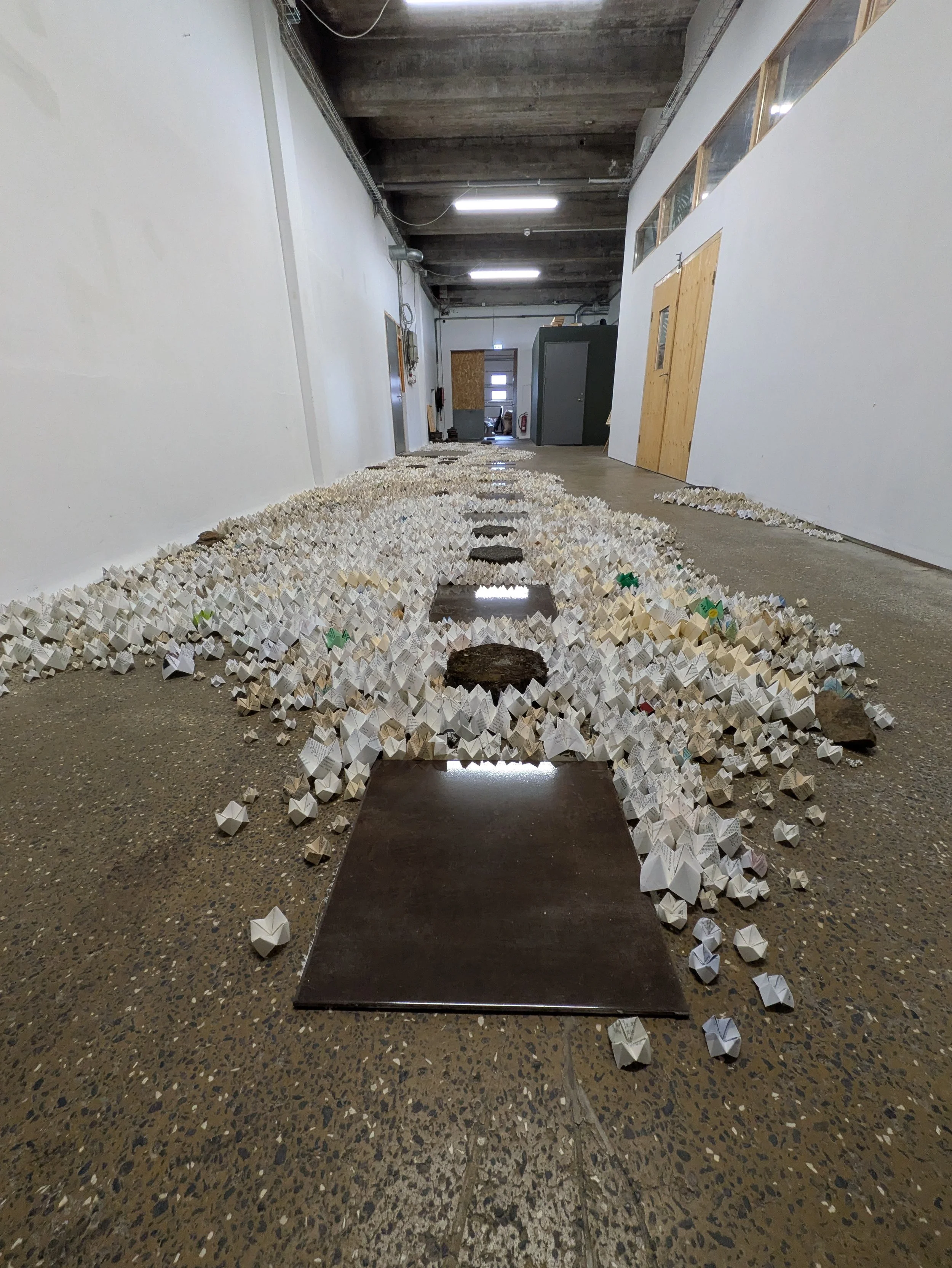
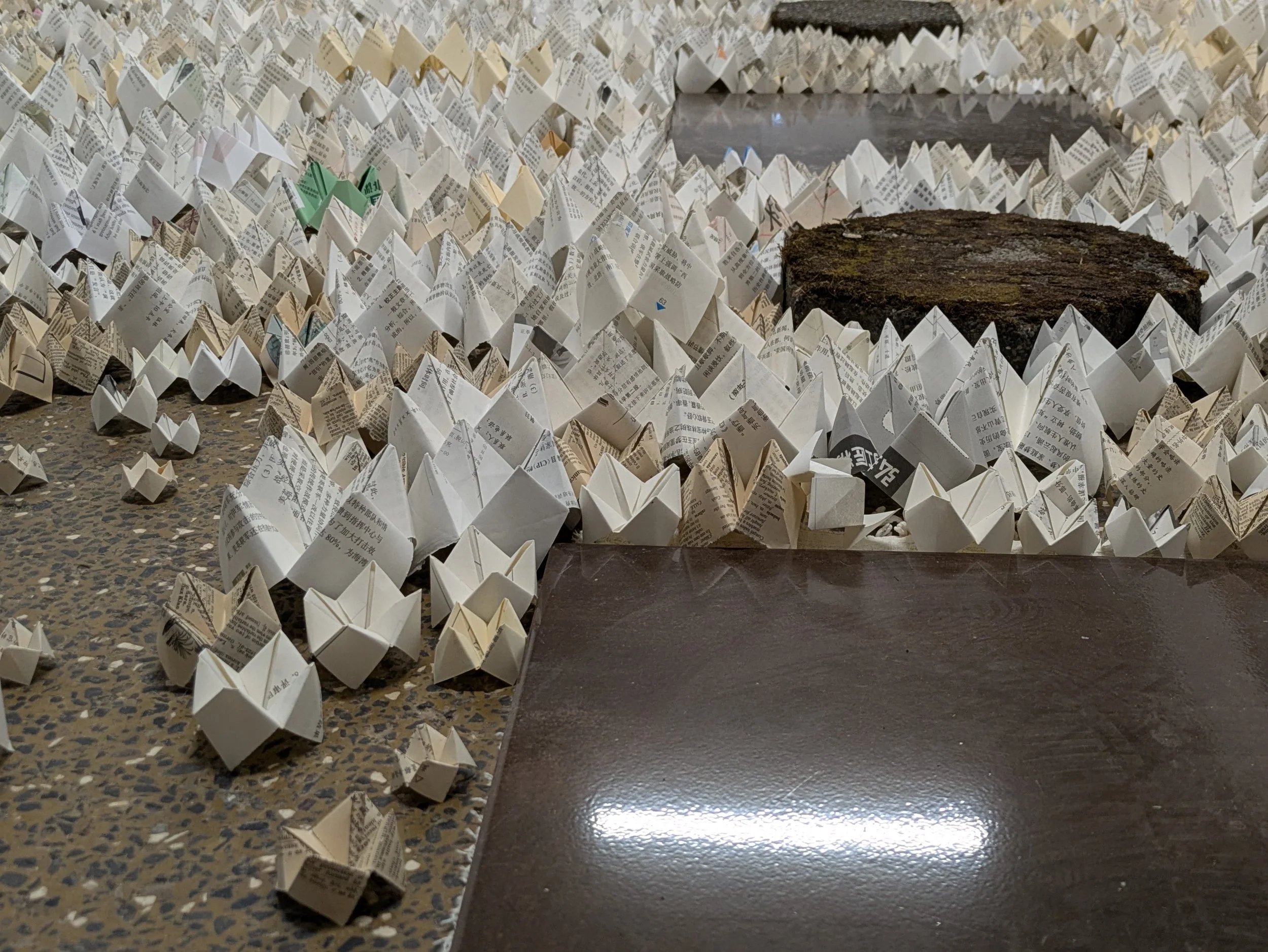
In her statement the artist wrote, “As each page is added, the piece changes, raising questions about the boundary between creation and destruction while giving discarded books a new life, function and meaning.” This framing of her project has given me some food for thought, since the idea of a tension between creation and destruction of books also applies to the blackout poems I’ve been making from secondhand paperbacks.
The destruction of books continues to be, for many people, a sensitive and even shocking subject. This attitude can come as a surprise to me when I encounter it now, probably because I have worked in traditional publishing and DIY book production for so long that the idea of a book as a venerated or inherently valuable object no longer feels true to me. But I certainly grew up with the idea instilled in me. I have a viscerally guilty early childhood memory of cutting pictures out of my family’s encyclopedia set and pasting them into a school project to “illustrate” it. I was a kid and did this in all innocence and ignorance, but the sense of shame my parents, or possibly my teacher, passed on to me when I explained where I got the pictures from still clings to the memory. Shame, and the resultant glow of sacred untouchability that this dusty old set of encyclopedias, which had been tucked away and forgotten on some old bookcase in our attic, took on after this incident.
Just last week, after I’d hung my poems in the gallery and was showing them to one of the museum’s young staff members, she gasped at the idea of a book being destroyed. I reassured her that the pieces on the wall were prints and kept to myself the fact that I’d made those prints from book pages I’d already torn out and mutilated. (I was, however, gratified to learn that my homemade prints were so convincing. To make them, Joe and I took high-res scans of the pages and then printed these onto cotton paper in our “print shop” in our home studio. I carefully cut each one out in the shape of the book page and, using a ruler as a straightedge, tore one side by hand to suggest that the paper had been torn from a book. I think this trick was effective. The different shades of the books’s whites and yellows came through nicely in the prints, too.)
In today’s manufactured world of so much excess, an unwanted object may be shared and used again by someone else, repurposed for a different use, or simply thrown away, or the materials that were used to make it can be recycled. Those are the options. Mass paperback books are not rare in any sense, and only become so when the book is long out of print and hard to find, or perhaps if a particular copy is from a limited or early run of a book that later became significant in some way.
In essence, the books I used for my poems were already trash when I found them being given away—for free in “little library” boxes or for a dollar or two at the thrift store. Is a book more than a mere object because of what it contains? Is using a book to make something new more, less, or equally valid than reading that book—i.e., “using” it for its intended purpose? Food for thought, open to discussion. Thank you for the inspiration, Saga—whose name, of course, means story.
Friday, Sept. 11
Lots of stories in the news from home today on the anniversary of September 11. It was a quiet workday for Joe and me, and we stayed in the apartment working on poems (me) and songs (him). After dinner we took a walk down to the réttir, to see how long of a walk it is and think about tomorrow’s sheep round-up. We’ve been looking forward to it since we got here and we plan to make audio recordings of the event, so we want to be prepared.
At Skriðuklaustur we’re out in a rural area, surrounded by mountains and farms. There are sheep everywhere, and for the last two weeks, the very end of summer, many of them have still been living wild—roaming on the hills, in the woods, way up on the ridges of the highlands, and chilling alongside rivers and creeks. This is how farmers in Iceland have raised sheep for hundreds of years. From early to mid summer until the beginning of autumn they run free, and before the weather turns too cold they have to be collected and brought back home. That’s actually what Gunnarson’s Advent is about: an intrepid farm worker who goes out into the blizzards of December to find any stray sheep that might have been missed. The réttir has been conducted for 1,000 years and is one of Iceland’s oldest cultural traditions. We walked until we saw the round-up pen, then turned back as it started getting dark. The wind felt colder than it has since we’ve been here. It blew us back to the house.
Saturday, Sept. 12
Around noon Joe and I got dressed in several layers and stepped out front to take a peek, wondering if the sheep had begun their procession, and we could already hear it: hundreds of sheep bleating as they went right down the middle of the road. A river of them. Most of them white, plenty of black and the occasional delightful brown. We waited until they had all passed the driveway, having been warned not to get in the middle and risk scaring them and sending them running in the wrong direction, and joined the parade by bringing up the rear.
All around us were farmers and their helpers, a few people on ATVs, and some on horseback. Families, old people, lots of little kids, a decent number of babies being pushed in strollers. We all pitched in by clapping and shouting at wayward sheep. The main thing Joe and I were doing, though, was recording everything with our field recorder so we could make a record of the day.We knew we’d see Ásdis from Skriðuklaustur today because she told us she’d be working with her family. And there she was, running alongside the road with her little dog, both of them chasing the sheep along. There were other people like us, visitors taking photos, but it can’t have been more than 100 people total and we were all sort of in the mix, helping out by shouting and clapping.
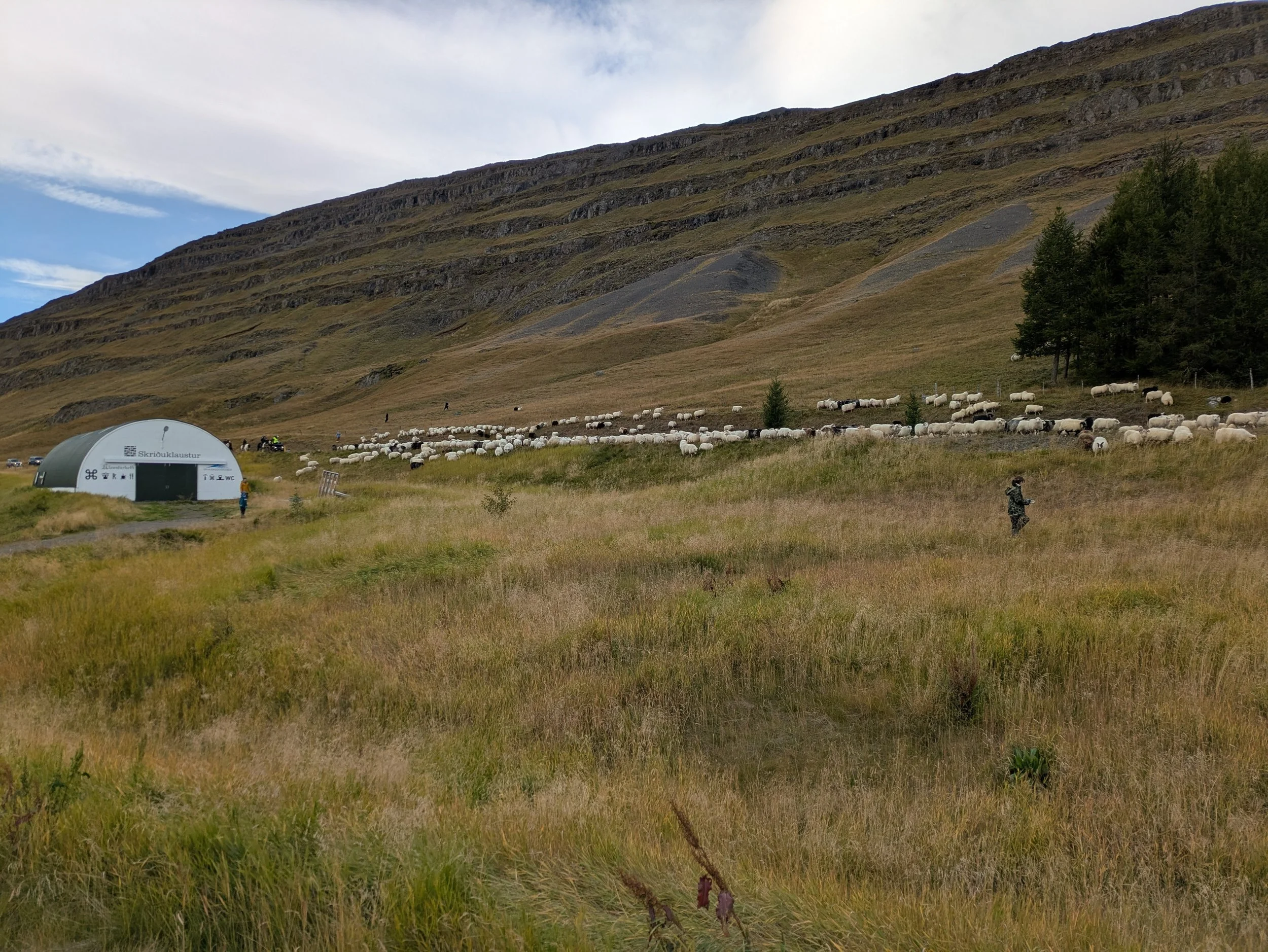
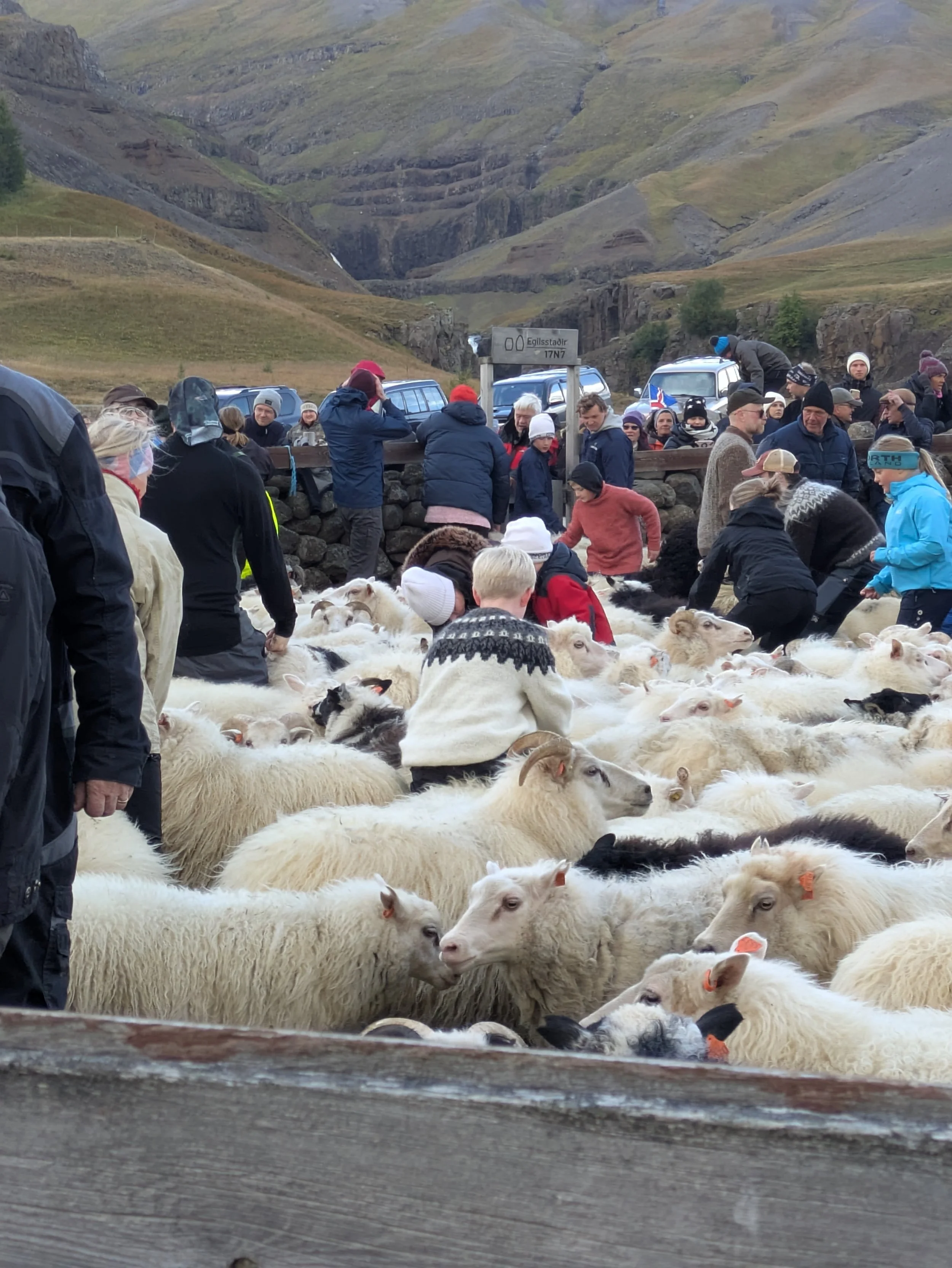
Another woman from Skriðuklaustur was working that day, and she encouraged us to jump into the fray and wrangle some sheep ourselves. Ridiculous, but how could I say no? I did as a woman in the ring told me and dragged a sheep across the ring by its horns, worried I was hurting it. Ásdis showed me how to get one without horns, too, which was harder. She straddled it and took hold of handfuls of wool just under its chin and pulled its head up, then had me stand behind her so I could do the same and she could pass the sheep off to me. These animals are strong and stubborn and do not want to be caught, so it was a challenge that I was mostly not up to, though I did bring a few to the right pens. We weren’t the only non-farmers—it’s so much work that anyone can volunteer to help out. We trudged back to the flat tired and sweaty, with recordings of all the voices and animal sounds to cut them onto records.
Tues., Sept. 15
I’ve been slacking on keeping this diary for a few days now. I think it’s because ever since we did our event on Sunday I’ve been feeling the end of this residency beginning, and it’s making me feel sad to think about it.
Things went well on Sunday: We walked out the back door of our apartment right into the museum itself, carrying our record lathe, and set it up in the room where Gunnarson’s desk and family photos are exhibited. We set it up on his writing desk, as a matter of fact. I felt uncertain about whether or not this was proper but the museum guide just shrugged and said, We just have to move this, picking up and taking away the old typewriter that was sitting on it. So that was that.
Oddny set out beautiful chocolates and water she’d added berries to and tea she made with herbs from the garden. And she treated me and Joe to a meal from the cafe—a delicious sweet cheese dish and meat that I’m pretty sure was reindeer. No one particularly knew if anyone would show up to this event we’d cooked up, so it felt good when a nice handful of people did. The room filled up with folks interested in seeing how the machine works and getting records cut—their metal bands, voicemails, band rehearsals from yesteryear—and Joe and I had a good old time doing it, as we always do. It’s very tiring, standing and working and being “on” like that for several hours, but it’s good for me. It boosts my confidence, remembering that I can meet strangers and talk about my work, and always connect with them on a deeper level, too. Something about people trusting us with something personal to them, and us making a little gift out of it.
We cut records for about 10 people and gave away a handful of the réttir and music ones we made. A cool woman and her husband and their cheerful baby came out—the baby was the one Joe “met” last week when he was downstairs drinking a beer at the cafe and came back up saying, I met a baby and talked to him in Icelandic! We learned that the baby’s father is the “mountain king,” not like Peer Gynt, but the leader of the local sheep roundup. I’d learned this wonderful phrase when I read about the tradition and was pretty excited to meet the man himself. There was even someone who came out to get a record and was kind enough to look at my show downstairs, and afterward we had a great conversation about the poems. I’m so glad I took the opportunity to show them here.
Wednesday, November 18
There’s one thing I didn’t write about while I was still in Iceland, but I want to tell you about it now.
Most evenings Joe and I went for a walk after dinner. Sometimes we tramped around in the fields behind the house, which were covered in such fluffy, tall grasses that it made for a pretty athletic walk. After awhile we realized that we could walk right down the middle of the road—cars travel fast, but there are very few of them, and when one is coming you can hear or see it from miles away. We’d pick a direction and walk until we were tired, or until the cold wind started to get in under our clothes.
One evening a few days before we left we were feeling a little restless, unhappy about having to go back to The Crazy Place, aka our country, where things have felt so shitty and difficult for so long. We walked in the direction of the réttir and passed a small waterfall on the opposite side of the street. This county is full of waterfalls so we hadn’t particularly paid attention to this one, but tonight felt different, so we decided to walk up through the grass toward it and found we could get closer and closer, that the falling water was nestled deep in a rock face that seemed to open up to us as we moved toward it, as lush and magical as a fairy glen. There was no one around; there was never anyone around the whole time we spent in the valley; and this enchanted space felt like it belonged to us, like it had been sitting there untouched for thousands of years until we happened along, though in reality it’s a just a local beauty spot—one of zillions—that’s already loved and used by the locals, one of whom we’d spied having his lunch up there a few times when we drove past.
It was so green, so alive. Wet grass and spongy moss and shining rocks. I don’t have any pictures to show you because I didn’t take any. Once we’d walked off the road even the thought of other people fell away, and as I walked further and further into the rock I had the weirdest sensation that I could disappear into this place, if it would open up to accept me. A feeling of disintegration of self and integration into something much bigger, something unified and all-encompassing. It was a holy moment, just a moment but it suspended itself and hung over us and protected us, and the air on my face was cold and fresh. And then it started to get too dark and Joe and I looked at each other and knew we had to go leave and go back into the rest of the world.
